Investor note: When evaluating QQQM vs QQQ, long-term Non-Resident Alien investors should switch to QQQM because it tracks the exact same Nasdaq-100 index while charging a lower 0.15% expense ratio and offering a lower share price for easier cash deployment.
For decades, Invesco QQQ served as the default gateway for international investors seeking exposure to American technology giants like Apple, Microsoft, and Nvidia. However, paying a 0.20% annual fee for day-trading liquidity makes little sense for offshore wealth.
Real life Experience of The Investor
Invesco launched the Nasdaq 100 ETF (QQQM) specifically to solve this structural inefficiency for buy-and-hold investors. While Wall Street options traders still rely on the legacy QQQ ticker for its massive daily trading volume, global retail investors have different priorities.
When you transfer foreign currency across borders to accumulate dollar-denominated assets, every basis point saved on internal management fees stays inside your brokerage account to compound uninterrupted over time.
Beyond expense ratios, understanding how Nasdaq-100 funds interact with United States tax regulations is critical for Non-Resident Aliens. Because technology companies typically reinvest cash flows into research and stock buybacks rather than paying high dividends, both funds offer strong tax efficiency against the thirty percent withholding rule.
By pairing the lower cost structure of QQQM with a valid Form W-8BEN, international investors capture American innovation with minimal cross-border friction.
Differences Between QQQM and QQQ
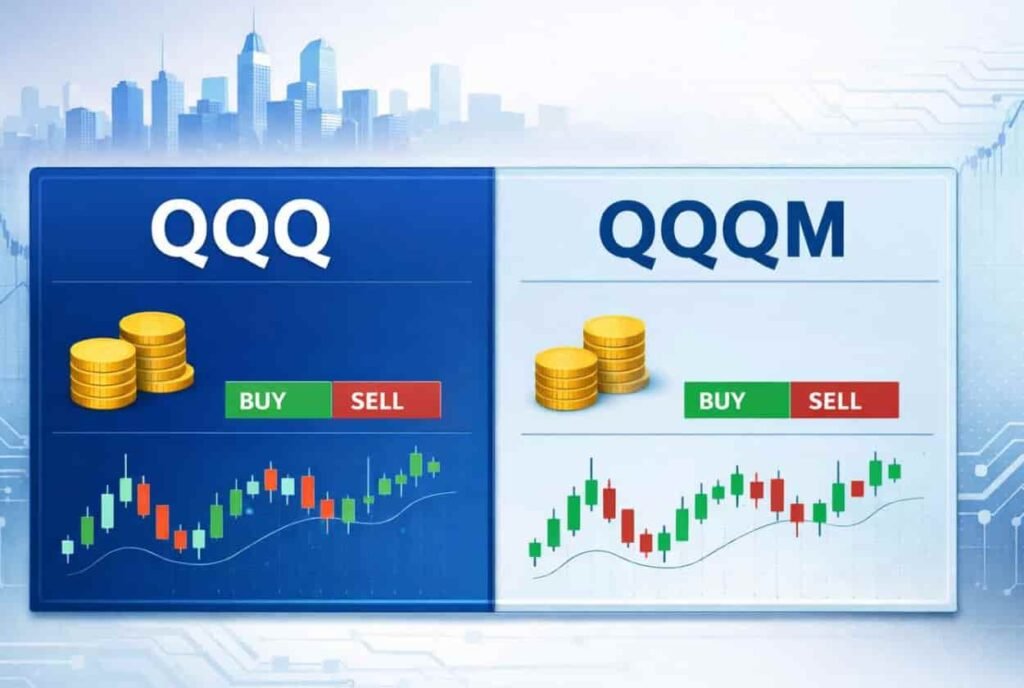
The primary catalyst in the qqqm vs qqq debate is the five-basis-point reduction in annual management costs, dropping from 0.20% on QQQ to 0.15% on QQQM. This fee difference stems from their legal architectures under United States securities law.
The original QQQ is structured as a legacy Unit Investment Trust (UIT), an older format that prohibits reinvesting dividends internally or lending securities. Conversely, QQQM operates as a modern open-end fund, unlocking efficiencies that lower shareholder costs.
Share price accessibility represents another operational victory for international retail investors choosing QQQM over its older sibling. Many cross-border brokerages restrict fractional share trading for Non-Resident Aliens due to local custody regulations.

Dollar Prica and Trades in QQQM
Because a single share of QQQ trades at a much higher dollar price than QQQM, investors making modest monthly deposits often suffer from cash drag while waiting to afford a full unit. Utilizing QQQM’s lower entry price lets you deploy United States Dollars immediately.
The only metric where QQQ decisively beats QQQM is institutional trading liquidity and options market depth.Billions of dollars in QQQ shares change hands every minute, resulting in microscopic bid-ask spreads of a single penny.
While QQQM exhibits slightly wider spreads and lower daily volume, financial experts note that this distinction is irrelevant for investors holding positions for five to twenty years. Unless you execute multi-million-dollar block trades, QQQM provides abundant liquidity for retail portfolios.

Tax Efficiency: Nasdaq-100 Non-Residents
For Non-Resident Aliens, the Nasdaq-100 index acts as a natural shield against the punitive thirty percent dividend withholding tax levied by the Internal Revenue Service. Unlike broad value funds or the S&P 500 (SPY or IVV), which distribute higher quarterly yields, Nasdaq-100 constituents prioritize share buybacks and capital appreciation.
Because the dividend yield on QQQM hovers around 0.60%, the cash lost to statutory IRS withholding is minimal, allowing your capital to compound through tax-exempt price growth.
Even with a low baseline yield, optimizing your cross-border tax profile remains mandatory to prevent unnecessary leakage over a thirty-year horizon. International investors comparing Nasdaq-100 vehicles should evaluate three core operational factors before executing their next buy order:
- Dividend Withholding Rate: Submit Form W-8BEN to reduce the 30% default IRS tax on QQQM distributions to 15% under valid US tax treaties.
- Zero Capital Gains Tax: Non-Resident Aliens pay 0% US tax when selling QQQ to switch into QQQM.
- Estate Tax Threshold: Direct holdings in either US ticker count toward the $60,000 US-situs cap.
| Metric / Feature | Invesco QQQ Trust (QQQ) | Invesco Nasdaq 100 (QQQM) | iShares Nasdaq 100 UCITS (CNDX) |
|---|---|---|---|
| Expense Ratio | 0.20% Annually | 0.15% Annually | 0.33% Annually |
| Legal Structure | US Unit Investment Trust | US Open-End ETF | Ireland UCITS (Accumulating) |
| Share Price | High (~2.5x QQQM) | Low (Retail Friendly) | High (LSE / Xetra) |
| NRA Dividend Tax | 15% to 30% (W-8BEN) | 15% to 30% (W-8BEN) | 15% Internal Treaty |
| US Estate Tax | Yes (Over $60,000) | Yes (Over $60,000) | No (100% Exempt) |
The Hidden Risks in International Investing
Investing in high-growth American technology from abroad exposes your portfolio to structural hazards that extend beyond standard market volatility. While Tax Withholding on QQQM is naturally low due to minimal dividend payouts, failing to maintain an active Form W-8BEN still triggers the maximum thirty percent penalty rate.
More importantly, both QQQ and QQQM are US-domiciled funds, meaning any balance exceeding $60,000 exposes Non-Resident Aliens to the forty percent federal US Estate Tax upon death.
Investors who bypass this estate tax trap by purchasing Ireland-domiciled Nasdaq-100 UCITS funds (such as CNDX or EQQQ) must monitor Tracking Error, as higher European expense ratios (0.30% to 0.33%) cause slight performance deviations over time. Furthermore, utilizing borrowed brokerage funds to buy tech ETFs introduces severe Margin Risk.
Because the Nasdaq-100 experiences sharper drawdowns during downturns, leveraged foreign investors face sudden margin calls without the safety net of domestic tax-loss harvesting.

How FED Policy Impact Tech Returns
Because QQQM is heavily concentrated in mega-cap technology and growth equities, its price trajectory is sensitive to United States Federal Reserve monetary policy. When the Federal Reserve raises interest rates to combat inflation, future corporate earnings are discounted more aggressively, often causing temporary valuation compressions across the Nasdaq-100.
However, historical data suggests that dominant technology firms possess the fortress balance sheets and pricing power required to outpace broader macroeconomic slowdowns over full market cycles.
For Non-Resident Aliens currently holding the legacy QQQ ticker, transitioning to QQQM requires a disciplined look at your local tax jurisdiction. While the Internal Revenue Service does not tax capital gains realized by non-residents, selling profitable QQQ shares to buy QQQM is a taxable realization event in most home countries.
If selling triggers hefty domestic taxes, keep your existing QQQ shares untouched and direct all new monthly deposits and dividend cash flows into QQQM.
Frequently Asked Questions
Will I owe US capital gains tax if I sell my QQQ shares to buy QQQM?
No, as a Non-Resident Alien who is not physically present in the United States for 183 days or more during the year, your capital gains are exempt from US federal taxation.
However, selling QQQ at a profit may trigger local capital gains taxes in your country of residence. Always consult with a tax professional in your home jurisdiction before liquidating existing positions to ensure the fee savings outweigh local tax liabilities.
Does QQQM hold the exact same technology stocks as QQQ?
Yes, both exchange-traded funds are managed by Invesco and track the exact same underlying benchmark, the Nasdaq-100 Index.
When you purchase a share of QQQM, you gain identical proportional ownership in the one hundred largest non-financial companies listed on the Nasdaq exchange, including Apple, Microsoft, Nvidia, Amazon, and Meta. Your underlying asset allocation and sector exposure remain one hundred percent identical between the two tickers.
When should a foreign investor choose an Irish UCITS ETF over QQQM?
While QQQM is the superior US-domiciled choice due to its rock-bottom 0.15% fee, Non-Resident Aliens with portfolios exceeding $60,000 must prioritize US Estate Tax protection.
Once your total US-situs assets cross that sixty-thousand-dollar threshold, switching to an Ireland-domiciled accumulating UCITS equivalent like iShares Nasdaq 100 UCITS (CNDX) legally shields your heirs from the 40% federal estate tax, justifying the 0.33% annual European fee.

Your Cross-Border Nasdaq-100 Allocation
Upgrading your portfolio architecture rarely requires complex Wall Street maneuvers; often, it simply means replacing outdated legacy tickers with modern, cost-efficient equivalents. In the qqqm vs qqq comparison, Invesco’s newer offering clearly wins for international buy-and-hold investors.
By capturing the exact same powerhouse technology companies at a twenty-five percent discount on management fees and a more accessible share price, QQQM ensures that more of your capital remains invested and compounding in United States Dollars.
Take a few minutes during your next portfolio contribution cycle to update your brokerage watchlist and redirect fresh capital toward QQQM. Ensure your Form W-8BEN certification remains active to minimize dividend withholding,monitor your total portfolio balance against the sixty-thousand-dollar estate tax threshold, and avoid the temptation of margin leverage.
With a streamlined cost structure and proactive tax compliance, you can confidently harness the long-term growth of American innovation from anywhere in the world.