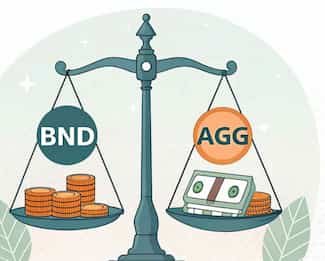
Editor’s Pick: When comparing BND vs. AGG, both ETFs track the U.S. aggregate bond market with near-identical performance and ultra-low 0.03% expense ratios, making them virtually interchangeable for core fixed-income exposure.
When constructing a resilient investment strategy, the debate between BND vs. AGG consistently takes center stage for income-focused investors. Balancing a high-growth equity allocation with stable fixed-income securities is crucial for long-term financial health.
These two titan exchange-traded funds offer unparalleled access to the broad domestic bond market, serving as the ultimate shock absorbers during periods of severe market turbulence.
By holding thousands of underlying assets, they provide instant diversification that single bonds simply cannot match. Understanding their nuanced mechanics empowers you to build a fortress around your hard-earned capital.
Investor Commentary about BND vs. AGG
Many investors feel anxious about making the wrong choice between two similar funds, and this is completely normal when real money is on the line. In my own journey managing a USD portfolio, I spent hours agonizing over tracking errors and minute yield differences between these giants. Eventually, I realized that the true value lies in the behavioral stability these funds provide, rather than chasing a 0.01% performance gap. Holding a massive, diversified bond fund allowed me to sleep peacefully during sudden equity drawdowns.
The peace of mind derived from owning highly rated government and corporate debt far outweighs the analysis paralysis of choosing between two virtually identical industry leaders.
Portfolio: How BND vs. AGG Function
Both of these massive funds operate by tracking the Bloomberg U.S. Aggregate Float Adjusted Index, offering broad, immediate exposure to investment-grade debt. By mirroring this benchmark, they systematically purchase a massive cross-section of treasury bonds, high-quality corporate bonds, and agency-backed securities.
This indexing approach ensures that the fund accurately reflects the current state of the domestic lending market without relying on active managerial speculation. Consequently, investors instantly acquire a perfectly weighted slice of the entire U.S. bond ecosystem, dramatically lowering the barrier to entry for professional-grade diversification.
The underlying asset allocation within these portfolios leans heavily toward government-backed securities, providing a robust anchor during economic distress. Both funds allocate roughly two-thirds of their holdings to U.S. Treasuries and mortgage-backed securities (MBS), which carry the highest credit ratings available.

Personal Risk Tolerance: BND vs. AGG
The remaining portion captures the slight yield premium offered by blue-chip corporate debt, balancing supreme safety with modest income generation. This specific blend of assets is meticulously designed to counteract the aggressive volatility typically found in the stock market, smoothing out the overall trajectory of your net worth.
It is generally observed by financial experts that holding a broad bond index significantly reduces single-issuer default risk. If a single corporation within the fund faces bankruptcy, the impact on the ETF’s total net asset value is mathematically negligible due to extreme diversification. Understanding your personal risk tolerance is essential, but placing capital into these vehicles is widely considered a prudent defensive maneuver.
Rather than attempting to predict interest rate movements or corporate defaults, utilizing these aggregate funds allows you to effortlessly capture the baseline yield of the safest debt markets in the world.

Expense Ratios and Liquidity: The Hidden Metrics
The cost of ownership for both Vanguard’s BND and iShares’ AGG is an ultra-low 0.03%, meaning investors keep almost all of their generated yield. When managing a long-term USD portfolio, minimizing fees is one of the few variables an investor can completely control. A lower expense ratio directly translates to higher compounding returns over a multidecade horizon, effectively leaving more money in your pocket rather than transferring it to fund managers. Furthermore, this aggressive cost-cutting forces the funds to maintain exceptionally tight tracking error margins against their target index.
Massive trading volume and deep liquidity characterize both of these instruments, ensuring that you can enter or exit positions with minimal bid-ask spreads. Whether you are executing a small monthly contribution or rebalancing a multi-million dollar account, the market easily absorbs the transaction without price slippage.
| Feature | Vanguard Total Bond Market (BND) | iShares Core U.S. Aggregate Bond (AGG) |
|---|---|---|
| Expense Ratio | 0.03% | 0.03% |
| Net Assets (Approx) | $300B+ | $100B+ |
| Primary Holdings | U.S. Treasuries, MBS, Corporate | U.S. Treasuries, MBS, Corporate |
| Dividend Frequency | Monthly | Monthly |
This level of institutional liquidity guarantees that your capital remains highly accessible, functioning as a superior alternative to locking funds in individual, illiquid municipal or corporate bonds.

Yield Dynamics: Understanding Returns
Yield performance between these two ETFs remains historically correlated, with both reacting similarly to Federal Reserve interest rate shifts. Because they hold identical types of fixed-income securities, their net asset values naturally fluctuate inversely to broader interest rate movements. When central banks raise rates, the existing bonds within the funds momentarily lose market value, yet the newly purchased bonds begin generating higher yields.
This mechanical relationship, known as duration risk, means that while short-term principal values may dip, the long-term income-generating power of the portfolio actually strengthens over time.
Both ETFs distribute dividend payments on a monthly basis, providing a highly reliable stream of passive income for retirees and aggressive accumulators alike.

BND vs. AGG ETFs Regular Payouts Tips
These regular payouts can be systematically reinvested to accelerate compound interest or used to cover living expenses during economic downturns.
- Federal Reserve monetary policy decisions and rate hikes.
- Shifts in global macroeconomic inflation expectations.
- Overall credit quality upgrades or downgrades within the domestic market.
- Supply and demand dynamics for short-term and long-term U.S. Treasuries. Understanding these underlying forces demystifies the monthly fluctuations in your brokerage statement, allowing you to view yield changes through a strategic, macro-economic lens.
Financial analysts suggest that while past performance does not guarantee future results, these funds are observed to stabilize portfolios effectively during equity market crashes. By acting as a non-correlated asset class to stocks, they provide vital capital preservation exactly when investors need it most. When panic selling grips the stock market, institutional capital typically flees into the safety of the exact government bonds held by BND and AGG.
This flight to safety generally drives up the value of your bond allocation, providing you with preserved purchasing power to opportunistically rebalance into discounted equities.

Tax Efficiency: Strategies for USD Portfolios
Placing broad bond funds in tax-advantaged accounts is highly recommended by experts to shield ordinary income distributions from high tax brackets. Because the monthly payouts from BND vs. AGG are taxed as ordinary income rather than qualified dividends, holding them in a taxable brokerage can create a noticeable tax drag.
Strategic asset location dictates that these high-yield, low-growth assets belong in IRAs or 401(k) equivalents whenever possible. By optimizing where you hold these assets, you effortlessly maximize your after-tax returns without altering your fundamental risk profile or investment strategy.
The ETF creation and redemption mechanism intrinsically minimizes taxable events related to capital gains for long-term buy-and-hold investors. Unlike mutual funds, which must sell underlying assets to accommodate departing shareholders, ETFs utilize in-kind transfers that do not trigger taxable events for the remaining pool of investors.
This structural advantage makes them incredibly efficient vehicles for accumulating wealth over decades. Consequently, even if you are forced to hold them in a taxable account, you are largely insulated from the surprise year-end capital gains distributions that traditionally plague actively managed bond mutual funds.
Securing Your Financial Future
Taking action to balance your portfolio with either of these core bond funds immediately enhances your defense against unpredictable market volatility. Establishing a dedicated allocation to investment-grade debt provides the structural integrity required to weather inevitable economic recessions without panic selling.
By committing to a strict portfolio rebalancing schedule, you essentially force yourself to buy low and sell high across different asset classes. This mechanical, emotionless approach to wealth management transforms market chaos into a systematic opportunity for steady, compounding growth within your comprehensive USD portfolio.
Many novice investors feel overwhelmed by complex asset allocation models, and this is completely understandable when navigating volatile and unpredictable markets. The financial industry often profits from making investing appear infinitely complex, but the reality is that pairing a global stock fund with either BND or AGG creates a nearly flawless, lifelong strategy.

Dollar-cost Averaging and Investment Horizon
Focusing on your unique investment horizon rather than daily market news drastically reduces stress and decision fatigue. Simplifying your holdings down to these fundamental building blocks allows you to reclaim your time while ensuring your financial trajectory remains fiercely protected.
It is widely suggested by portfolio managers that starting with a core holding like this establishes a resilient, professional-grade financial foundation. Utilizing automated dollar-cost averaging to slowly build your position eliminates the impossible task of timing the bond market. Whether you choose the Vanguard iteration or the iShares equivalent, the mathematical outcome over a twenty-year period is statistically indistinguishable.
The ultimate key to successful wealth accumulation is not obsessing over microscopic differences between identical index funds, but rather executing a consistent, disciplined savings strategy that leverages the compounding power of broad market participation.
FAQ and Answers for BND vs. AGG
What is the primary difference between BND vs. AGG?
The bottom line is that there is virtually no structural difference between the two, as both track the broad U.S. investment-grade bond market with identical 0.03% expense ratios.
While Vanguard’s BND tends to have a slightly larger pool of assets under management and includes a slightly different weighting of international dollar-denominated bonds, their historical total returns mirror each other almost perfectly. For the average retail investor constructing a diversified portfolio, these two exchange-traded funds are entirely interchangeable.
How often do these U.S. Total Bond Market ETFs pay dividends?
Both funds are engineered to distribute yield to shareholders on a monthly basis, making them highly attractive for income-focused investors.
These monthly distributions consist of the aggregate interest payments generated by the thousands of underlying government and corporate bonds held within the portfolio. Investors can choose to have these dividends deposited as cash for living expenses or automatically reinvested to purchase fractional shares, which significantly accelerates the compounding growth of their capital over time.
How do rising interest rates affect BND and AGG?
It is generally observed that when the Federal Reserve increases benchmark interest rates, the net asset value (NAV) of existing bond funds experiences a temporary decline.
However, this is a normal mechanical feature of fixed-income investing, not a permanent loss of capital, assuming the investor holds the fund through its average duration. Over time, as older, lower-yielding bonds mature, the fund manager reinvests the capital into newer bonds boasting higher yields, ultimately resulting in larger monthly dividend payouts for the patient shareholder.