Editor’s Comment: VYM (Vanguard High Dividend Yield ETF) prioritizes immediate passive income through stocks with above-average yields, whereas VIG (Vanguard Dividend Appreciation ETF) focuses on long-term wealth compounding by targeting companies with a consistent history of raising dividends. This could be the shortest answer for VYM vs VIG.
For the international investor, navigating the U.S. market requires more than just picking winners; it requires understanding the fundamental mechanics of how capital is returned to shareholders. Whether you are building an early-stage portfolio or fine-tuning an income-focused retirement plan, the VYM vs VIG debate centers on the classic trade-off between current lifestyle funding and future purchasing power.
In this guide, we strip away the complex jargon to provide a clear, evidence-based roadmap for your dividend investing journey, ensuring your capital is positioned for both resilience and growth in an ever-fluctuating global market.
Investors’ View
Many individual investors feel intense anxiety when choosing between these two giants, fearing that one wrong move will derail their retirement savings, and this feeling of overwhelming responsibility is completely normal.
It is crucial to remember that financial freedom is not built on selecting the “perfect” fund, but on maintaining a consistent, long-term strategy that aligns with your personal risk tolerance and comfort level.
VYM vs VIG: Understanding the Strategies
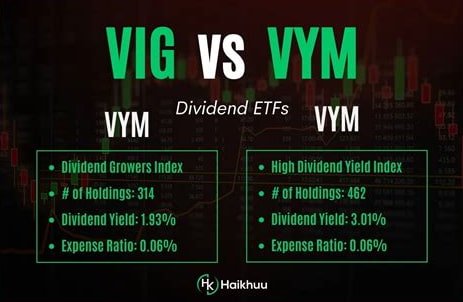
The fundamental difference in the VYM vs VIG comparison lies in their indexing methodologies: VYM tracks the FTSE High Dividend Yield Index, selecting companies with the highest current dividend payouts, while VIG tracks the S&P U.S. Dividend Growers Index, specifically filtering for companies that have increased dividends for at least ten consecutive years.
Dividend yield is the headline metric for VYM, making it a staple for investors seeking immediate cash flow, whereas dividend growth is the North Star for VIG investors, who prioritize companies with robust balance sheets and sustainable capital allocation practices.
Historically, companies that consistently grow their dividends tend to be higher-quality, more mature businesses with significant competitive advantages and pricing power in their respective sectors. These “Dividend Aristocrat-style” firms often exhibit lower volatility compared to high-yield stocks, as their growth is driven by earnings expansion rather than just reaching for higher payout ratios.

Cash Flow Stability and Asset Allocation
Conversely, VYM often includes companies in mature industries—such as energy, tobacco, or financials—that may be stable but offer limited long-term capital appreciation, making them ideal for the “income-now” investor but less suitable for those looking for multi-decade wealth compounding.
Choosing between these strategies requires a deep look at your current lifecycle stage and financial goals. An investor nearing retirement might favor the cash flow stability provided by VYM, whereas a younger investor with a longer time horizon might find the total return profile of VIG more compelling for aggressive wealth building.
Expert market analysis suggests that neither fund is objectively “better,” but rather that each serves a distinct role within a balanced asset allocation framework, providing exposure to different slices of the U.S. equity market landscape.

High Yield Dynamics: The Role of VYM in an Income Portfolio
VYM serves as an efficient vehicle for investors who require consistent dividend income to fund their current living expenses, effectively utilizing high-payout stocks to generate reliable cash flow. Because VYM screens for the top 50% of forecast dividends, it inherently tilts toward companies with lower growth prospects that are returning a larger portion of their earnings to shareholders to keep investors interested.
While the yield is attractive, it is important to monitor the payout ratios of the underlying holdings to ensure these dividends are not at risk of being cut due to declining business fundamentals.
For many investors, the primary appeal of VYM is the psychological comfort of seeing regular cash hitting their brokerage accounts, regardless of broader market direction. In turbulent economic times, these high-dividend stocks often provide a “floor” for the portfolio value, as income-oriented buyers step in to purchase the shares when the yield becomes particularly attractive.
However, this focus on yield can sometimes lead to an over-concentration in cyclical sectors, such as energy or utilities, which can be sensitive to interest rate changes and global commodity prices, requiring investors to stay vigilant about sector diversification.

Dividend Appreciation Dynamics: Why VIG Focuses on Quality
VIG is engineered for investors who prioritize total return over current yield, betting on the theory that companies with a multi-year history of dividend increases possess the financial discipline to outperform the broader market over time.
By filtering out firms that have cut their dividends, VIG effectively creates a “quality screen,” concentrating the portfolio in companies that are highly profitable and have manageable debt levels. This structural focus makes VIG a potentially powerful tool for those seeking to build wealth while simultaneously mitigating some of the downside risk associated with highly speculative or over-leveraged growth stocks.
The magic of VIG lies in the compounding effect of dividend growth; as the underlying companies raise their payouts annually, the investor’s yield on cost increases significantly over a long-term horizon. This dynamic provides a natural hedge against inflation, as the dividend increases often keep pace with or exceed the rising cost of living, preserving the long-term purchasing power of the capital.
Financial analysts have observed that while the initial yield on VIG is usually lower than that of VYM, the capital appreciation of the share price, driven by earnings growth, consistently compensates for the lower starting income, ultimately delivering superior total returns in many economic cycles.

VYM vs VIG: Performance Comparison Table
When comparing VYM vs VIG, the quantitative data reveals that while VYM consistently provides higher immediate current yield, VIG typically outperforms on a total return basis over multi-year periods due to its superior share price appreciation.
Performance data from institutional databases shows that the “Dividend Growth” factor has been one of the most reliable drivers of market-beating returns over the last two decades.
While VYM has its place in income-heavy portfolios, the data consistently points toward VIG as a stronger core holding for wealth accumulation, largely due to its focus on high-quality companies with durable earnings power.
To make an informed decision for your investment journey, consider the following structural differences that affect both the risk and return potential of these two popular Vanguard ETFs:
| Structural Factor | VYM Characteristics | VIG Characteristics |
| Yield Expectations | Offers a 1% to 1.5% yield premium; superior for immediate budget funding. | Typically lower initial yield compared to VYM. |
| Sector Exposure | Significant exposure to Financials, Energy, and Consumer Staples. | Often overweight in Technology and Industrials. |
| Volatility Profile | Higher relative volatility. | Generally exhibits lower standard deviation; smoother ride during market corrections. |
| Growth Potential | Lower long-term share price growth focus. | Holdings selected for ability to reinvest earnings, fueling share price growth. |

Expense Ratios With Opportunity Cost
Investors should also be aware that the expense ratios for both VYM and VIG are highly competitive, which ensures that the majority of the dividend income flows directly to the investor rather than being eaten up by management fees.
However, the true cost of these investments is not just the expense ratio, but the potential opportunity cost of choosing the wrong fund for your specific financial goals.
By conducting a thorough analysis of your personal cash flow requirements against your long-term wealth targets, you can determine if the immediate income of VYM or the compounding strength of VIG better fits your portfolio structure.
Risk Management: Sector Weighting and Market Exposure
The risk profiles of VYM vs VIG are heavily influenced by their sector weightings, which can cause them to react very differently to macroeconomic shocks and changing industry dynamics. VYM’s reliance on high-dividend industries means it can be sensitive to sector-specific downturns, such as an oil price collapse impacting energy holdings or a banking crisis affecting financial firms.
Conversely, VIG’s tilt toward large-cap technology and high-quality industrials makes it sensitive to valuations in the growth space, requiring the investor to be mindful of how these ETFs complement their existing core portfolio holdings.
Smart diversification involves understanding that these two ETFs, while both focused on dividends, actually behave like different “asset classes” under the hood. An investor holding both VYM and VIG can achieve a blended approach, capturing the stability of current income while simultaneously participating in the growth of high-quality companies.

This hedging strategy is highly effective for international investors, as it provides exposure to the strength of the U.S. corporate balance sheet from two different angles, ensuring the portfolio is robust enough to weather various market environments without becoming too reliant on a single style of investing.
Frequently Asked Questions: VYM vs VIG
Can VYM and VIG be held together in the same portfolio for optimal results?
Absolutely, combining VYM and VIG is a common and highly effective strategy for investors who want to balance immediate cash flow needs with long-term wealth growth.
Holding both ETFs allows you to enjoy the “best of both worlds,” utilizing VYM to cover near-term expenses while letting the high-quality, growth-oriented companies in VIG compound over the next several decades.
Which ETF is better for a retiree who depends on quarterly dividend income?
For a retiree prioritizing predictable income, VYM is generally the superior choice due to its higher initial dividend yield and focus on established, mature companies.
The goal of this phase of the investor lifecycle is capital preservation and income generation, and VYM’s design aligns perfectly with these priorities.
Do these ETFs offer international exposure, or are they only focused on U.S. companies?
Both VYM vs VIG are primarily focused on U.S.-based equities, meaning they provide minimal direct exposure to international markets. For an international investor looking to broaden their reach, these ETFs should be considered part of the “U.S. portion” of their global asset allocation.