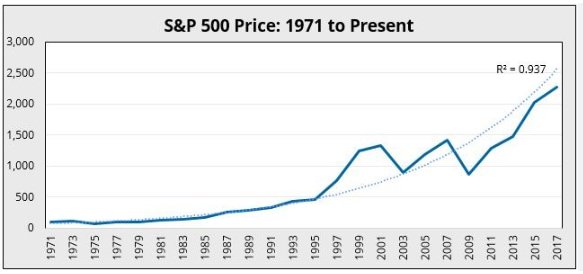
Editor’s Choice: Analyzing S&P 500 Historical Returns reveals a remarkably consistent, century-long wealth-building engine, delivering an average annual return of approximately 10% since 1926, establishing the U.S. Stock Market as the ultimate global financial sanctuary. While amateur traders obsessively panic over terrifying short-term volatility and unpredictable market corrections, rigorous data analysis proves that the broader market persistently maintains an unbreakable upward trajectory over extended decades.
Because the S&P 500 index exclusively houses the 500 largest, most robust corporations driving the global economy, it inherently serves as a powerful, inflation-resistant shield offering extraordinary compound growth to disciplined global investors.
What do these transparent historical datasets actually mean for your future investment strategies? The vast majority of global investors commit the fatal error of constantly attempting to perfectly time their market entry, whereas true generational wealth is directly correlated to your total time remaining continuously invested in the market.
In this comprehensive guide, we will deeply decode the exact semantic depth of historical bull and bear cycles, analyzing the underlying macroeconomic mechanisms that legendary Wall Street institutions utilize daily.
The Core Dynamics Driving Historical Market Growth
The fundamental momentum behind the index’s historical growth heavily relies on the simultaneous operation of relentless technological innovation, robust corporate earnings expansion, and the massive, hidden power of continuous dividend reinvestment. Focusing solely on raw price appreciation drastically fails to capture the true wealth-generating potential hidden within the comprehensive S&P 500 Historical Returns charts.
When we meticulously examine historical data, it becomes undeniably clear that nearly 40% of the total accumulated returns stem directly from corporations consistently distributing dividends that are patiently reinvested back into the exact same index. This colossal compounding effect is the ultimate financial leverage that forces time to work relentlessly in the investor’s favor.
When we dive into the semantic depth of exactly “why” these mechanisms function so flawlessly, we uncover the inexhaustible innovation capacity and rapid free-market adaptation inherent to the American economy.

US Stock Market ve Portfolio Theory
The renowned index is absolutely not a static, unchanging entity; rather, it possesses a ruthless, Darwinian survival mechanism that continuously expels failing, obsolete companies and rapidly incorporates hyper-growth technology giants. This natural selection process inherently guarantees that U.S. Stock Market participants are permanently partnered with the most aggressively competitive, highly profitable corporations dominating the unfolding global growth narrative.
To validate this with hard statistics, even though major catastrophes like the 2008 Global Financial Crisis or the devastating 2020 Pandemic crash caused terrifying drops exceeding 30%, the broader market aggressively recovered these severe losses within an average of just 18 to 24 months. Modern portfolio theory strongly advises international investors to rigorously employ a disciplined dollar-cost averaging strategy rather than attempting highly dangerous market timing maneuvers.
Financial history has proven countless times that those who panic and sell their shares during terrifying crises pay massive opportunity costs by completely missing the sharpest bull market rallies that immediately follow the darkest days.
The Hidden Power of Compounding Dividends
Moving beyond the raw index value, when dividend payments are systematically reinvested, the long-term trajectory of the S&P 500 transforms into a spectacular parabolic growth curve, providing the critical psychological anchor that sustains investors even through brutal bear markets. Dividends, essentially a corporation’s strict policy of sharing actual cash profits with loyal shareholders, organically and continuously increase the absolute number of shares an investor holds, even during pessimistic periods when the broader market trades completely flat.
Operating flawlessly on the mathematical logic of compound interest, this automated system allows the disciplined investor to maximize the snowball effect, officially transforming a standard portfolio into a generational wealth production center.
Historical datasets distinctly illustrate that the final financial gap between an individual who merely invested in the price index and someone who executed consistent dividend reinvestment since 1990 translates to a staggering difference of several million dollars. For this critical reason, when conducting an S&P 500 Historical Returns analysis for any international portfolio, one must exclusively focus on the “Total Return” metric rather than just the superficial price changes.
Macroeconomic Cycles and Risks for Global Investors
Although the American stock market remains the unshakeable flagship of the global economy, intelligent international investors must meticulously calculate short-term risk cycles triggered by macroeconomic fluctuations such as rising inflation rates, aggressive Federal Reserve interest policies, and sudden geopolitical crises. During highly tense periods of aggressively rising interest rates, risk-free yield instruments suddenly become highly attractive, often triggering temporary, massive capital outflows from global equity markets.
However, for highly disciplined global investors embracing a visionary long-term horizon, these temporary market drops frequently present golden opportunities to accumulate premium shares at significantly discounted prices, executing brilliant value investing maneuvers.
Regarding “how” to navigate these turbulent waters, the most reliable strategic answer is deeply hidden within intelligent portfolio diversification and rigorous risk management protocols. The vast S&P 500 index inherently houses a beautifully diverse array of contrasting economic sectors and dynamic corporate mechanisms:
- Technology and Innovation: The primary driving force carrying aggressive growth and massive profit margins.
- Healthcare and Consumer Staples: Highly reliable, defensive harbors during severe economic downturns.
- Financials and Energy: Powerful stabilizing elements that protect the index during shifting interest rate cycles.When high-growth technology stocks take a brutal beating, these other robust sectors efficiently balance the overall portfolio, actively minimizing catastrophic losses. This internal balancing mechanism makes U.S. Stock Market investments an incredibly safe, highly resilient financial sanctuary.
Table of Historical Reactions S&P 500
The structured table provided below clearly summarizes the historical reactions and average recovery times the S&P 500 has demonstrated during radically different economic cycles and unexpected global crises. These precise, scientific data points serve as an absolutely critical reference guide for deeply understanding the market’s true nature, empowering you to make entirely data-driven, highly rational strategic moves rather than succumbing to emotional panic during terrifying crashes.
| Crisis Period / Economic Event | Average S&P 500 Decline | Average Full Recovery Time | Strategic Investor Action |
| Dot-Com Bubble (2000-2002) | Approximately 49% | 4 – 5 Years | Pivot towards non-tech value stocks |
| Global Financial Crisis (2008) | Approximately 56% | 3 – 4 Years | Aggressive dollar-cost averaging at lows |
| Pandemic Crash (March 2020) | Approximately 34% | Just 6 Months | Avoid panic selling; hold shares tightly |
The Impact of Dollar-Denominated Returns on International Portfolios
BLUF: For visionary global investors residing completely outside America, S&P 500 Historical Returns are significantly impacted not only by raw equity performance but also by continuous fluctuations in the Dollar-to-Local Currency parity, adding a dual layer of potential return or complex risk to the portfolio. When an international investor strategically purchases assets within the U.S. Stock Market, they are automatically investing not just in American corporate growth, but also heavily in the enduring global dominance of the US Dollar.
If the investor’s native currency rapidly depreciates against the mighty dollar, they can mathematically secure massive local-currency gains even if the actual S&P 500 index remains completely stagnant.
However, it is absolutely vital to remember that currency risk actively works in both directions in complex international markets; a sudden, global depreciation of the dollar can slightly erode the high equity returns for international participants. To effectively neutralize these mandatory currency fluctuations, elite financial experts strongly recommend that investors avoid investing all their capital in a single lump sum, instead making regular, scheduled purchases across different exchange rates to establish a highly balanced average currency cost.
Through this strategic approach, investors uninterruptedly benefit from the innovative growth potential of the American economy while simultaneously building a massive, global financial armor against devastating devaluation risks in their local economies.

Frequently Asked Questions (FAQ) S&P 500
We are directly illuminating the most critical, highly searched long-tail questions regarding S&P 500 Historical Returns frequently asked by global investors aiming to initiate their wealth journey through the U.S. Stock Market, using entirely data-driven, crystal-clear answers.
Will investing in the S&P 500 truly protect me against severe global inflation?
Absolutely yes; when we rigorously examine historical data, even during terrifying periods where global inflation averaged well over 3%, the index consistently delivered a powerful average annual return of around 10%, definitively proving that it protects the investor’s purchasing power far above inflation and provides a massive real return.
Historically, when is the absolute best time to start investing in the S&P 500?
According to the unified consensus of elite financial experts, the absolute best time was “yesterday,” and the second best time is “today”; because systematically executing a dollar-cost averaging strategy by remaining continuously in the market generates vastly higher profits than dangerously attempting to perfectly time market bottoms.
Are the massive historical returns of the index an absolute, ironclad guarantee for future profits?
No, by its very inherent nature, absolutely no financial instrument can offer a 100% ironclad guarantee of future performance based on past data; however, the unparalleled adaptation capability of the American economy and the continuously self-renewing structure of the corporations within the S&P 500 provide an incredibly strong statistical probability that the positive, long-term growth trend will powerfully continue.
Should I panic and urgently sell my S&P 500 index funds during a brutal bear market?
No, historical datasets conclusively demonstrate that panic selling executed during terrifying bear markets causes severe, permanent financial damage to the investor; conversely, these dark periods represent the greatest golden opportunities to aggressively accumulate discounted shares, drastically accelerating your long-term wealth creation.
Start Your Future Wealth With Hard Data Today
In stark contrast to highly emotional decisions and short-term panics that constantly grip the financial markets, highly disciplined portfolio management firmly backed by a century of verifiable S&P 500 Historical Returns data is the most reliable, unshakeable compass global investors possess on their journey to absolute financial freedom.
There will undeniably always be new, terrifying crises, sudden market corrections, and aggressive recession rumors dominating global headlines; however, visionary investors who clearly see the macroeconomic big picture and confidently entrust their capital to the massive power of compound interest consistently emerge as the ultimate victors at the end of every economic cycle.
Choosing to actively partner in the spectacular growth story of American corporations is not merely a basic financial investment, but a profound manifestation of unshakeable trust in the incredibly bright future of global innovation.
The exact moment has arrived to confidently transform these transparent historical datasets into concrete, strategic action and firmly seize absolute control of your own financial destiny.
To powerfully leverage the unique, life-changing opportunities hidden within the U.S. Stock Market, you can immediately begin researching a highly reliable, low-cost S&P 500 exchange-traded fund (ETF) through your chosen international brokerage today, resolutely implementing your own dollar-cost averaging strategy with small, incredibly consistent steps.