
If you have decided to invest in the S&P 500, congratulations. You have already made one of the smartest financial decisions possible, putting your money into the 500 largest and most profitable companies in the United States. However, once you open your brokerage account, you are immediately faced with a confusing alphabet soup of ticker symbols. The two heavyweights in the ring are undoubtedly the Vanguard S&P 500 ETF (VOO) and the SPDR S&P 500 ETF Trust (SPY). (VOO vs SPY) At a glance, they look identical, tracking the same index and holding the same stocks like Apple, Microsoft and Amazon. So, does it really matter which one you pick?
The short answer is yes, it absolutely matters, especially if you care about compounding your wealth over the next twenty or thirty years. While both funds offer exposure to the US market, they serve two very different types of investors. One is designed as a highly efficient wealth-building machine for the everyday investor, while the other is a high-octane tool built for institutional traders and Wall Street pros. Understanding the subtle differences in their fee structures and liquidity can save you thousands of dollars over your investing lifetime.
In this guide, we are going to settle the VOO vs SPY debate once and for all. We will strip away the complex financial jargon and look at the raw data: the costs, the structures, and the hidden mechanics that affect your bottom line.
The Titans of Wall Street: Understanding the Basics
To understand the rivalry of VOO vs SPY, you first need to understand that they are essentially twins wearing different clothes. Both are Exchange Traded Funds (ETFs) that track the Standard & Poor’s 500 Index. This means if the S&P 500 goes up by 1%, both VOO and SPY should theoretically go up by 1%. They hold the exact same stocks in the exact same proportions. If you looked at the top 10 holdings of both funds today, you would see an identical list. Therefore, the decision isn’t about which fund picks better stocks—neither of them “picks” stocks; they just copy the index.
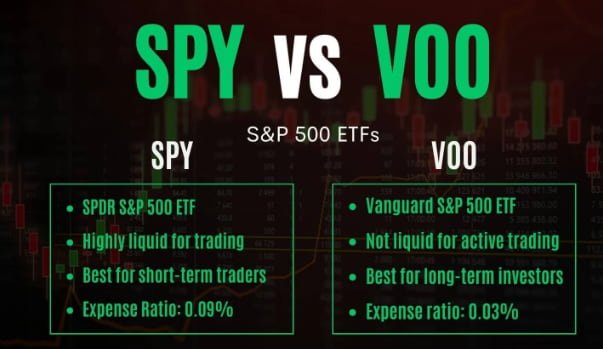
- However, the entities behind them are quite different. SPY is managed by State Street Global Advisors and has the distinction of being the very first ETF listed in the US, launching back in 1993. This first-mover advantage allowed it to become the largest and most traded ETF in the world.
- On the other side, we have VOO, managed by Vanguard. Launched much later in 2010, VOO was created with Vanguard’s core philosophy in mind: driving costs down for the average retail investor. While SPY has the history, VOO has the modern efficiency.
Same Destination Two Cars Example!
Because the underlying assets are the same, the difference in your total return will come down to “frictions“—specifically, the expense ratio (fees) and the bid-ask spread (trading costs).
Think of these funds as two identical cars driving to the same destination. One car (SPY) burns a little more gas per mile, while the other (VOO) is a hybrid designed for fuel efficiency. Over a short trip, you won’t notice the difference, but over a cross-country road trip—or a 30-year investment horizon—that fuel efficiency adds up to a significant amount of money.
The Price War: Expense Ratios and Fees
The most critical factor in the VOO vs SPY comparison is the expense ratio, which is the annual fee the fund manager charges to run the ETF. In this category, Vanguard’s VOO is the clear winner for the cost-conscious investor. VOO charges an expense ratio of just 0.03%. This means that for every $10,000 you invest, Vanguard takes only $3 per year. This is incredibly cheap and is one of the lowest fees you will find in the entire investment world.
In contrast, SPY charges an expense ratio of roughly 0.09%. While this is still considered low compared to actively managed mutual funds that might charge 1% or more, it is three times more expensive than VOO. For every $10,000 invested in SPY, you are paying about $9 per year. You might be thinking, “Who cares about a $6 difference?” And for a one-year hold, you would be right; it is negligible. But investing is rarely about a single year.
When you project this over decades, the difference compounds. If you have a portfolio worth $500,000 or $1,000,000 by the time you retire, that 0.06% gap starts to eat into your returns significantly. Over a 30-year period, investing in VOO instead of SPY could save you thousands of dollars in fees, money that stays in your account compounding rather than going to State Street.
Liquidity and Trading Volume: Where SPY Shines
If VOO is cheaper, why does anyone buy SPY? The answer lies in liquidity and volume. SPY is the most traded security in the world, with millions of shares changing hands every single second. This massive volume creates a very tight “bid-ask spread” which is the difference between the highest price a buyer is willing to pay and the lowest price a seller is willing to accept. For institutional investors, hedge funds, and day traders who are moving millions of dollars in and out of the market instantly, this liquidity is vital.
Because SPY is so liquid, it is the primary vehicle for the options market. If you are an advanced trader looking to hedge your portfolio with put options or generate income with covered calls, SPY offers a much deeper and more active options chain than VOO. The ability to enter and exit massive positions without moving the market price is worth the slightly higher expense ratio for these professionals. They aren’t holding the fund for 30 years; they might only hold it for 30 minutes.
However, for the average retail investor—the target audience of usmarketinvesting.com—this “advantage” of SPY is largely irrelevant. VOO is still incredibly liquid; you will never have a problem buying or selling your shares instantly. Unless you are managing a billion-dollar hedge fund or day-trading options for a living, the massive liquidity of SPY provides no tangible benefit to you. You are essentially paying a premium for a feature (extreme liquidity) that you will never use.
Dividend Reinvestment and Structure
Another subtle but important distinction in the VOO vs SPY debate is how they handle dividends. SPY is structured as a Unit Investment Trust (UIT). This is an older legal structure that requires the fund to hold uninvested cash dividends in a non-interest-bearing account until they are distributed to shareholders. This creates a phenomenon known as “cash drag” which can very slightly lower returns in a rising market.
VOO, on the other hand, is structured as an open-ended fund. This modern structure allows Vanguard to reinvest cash immediately or use it more efficiently within the fund before paying it out to you. While the performance difference caused by this is microscopic—fractions of a percent—it is another point in favor of VOO’s structural efficiency. It simply does a better job of keeping your money fully invested at all times.

Verdict for Long-Term Investors for VOO vs SPY
For 99% of the people reading this article, VOO is the superior choice. If your goal is to build wealth for retirement, save for a house, or generate passive income over the long haul, the math is undeniably on Vanguard’s side. The lower expense ratio of 0.03% ensures that you keep the maximum amount of your returns, and the structural efficiency minimizes cash drag.
When you are buying and holding, you want the ride to be as cheap as possible. Choosing VOO over SPY is the easiest way to instantly optimize your portfolio. It allows you to “set it and forget it,” confident in the knowledge that you are paying rock-bottom prices for top-tier market exposure. There is simply no reason for a long-term retail investor to pay the “SPY premium.”
The Verdict for Active Traders
Conversely, if you are a day trader or a sophisticated investor who heavily utilizes options strategies, SPY is your tool of choice. The penny-wide bid-ask spreads and the massive volume of the options market make it indispensable for short-term maneuvers. In this high-speed environment, the liquidity of the ETF matters far more than the annual expense ratio.
For traders, the 0.09% fee is just the cost of doing business in a highly liquid marketplace. If you need to dump a position in seconds or construct a complex multi-leg option strategy, VOO’s liquidity, while good, simply cannot compete with the sheer scale of SPY. Stick to SPY for your trading account, and keep VOO for your retirement account.

Conclusion: Making the Right Choice for Your Portfolio
In the battle of VOO vs SPY, there is no “bad” choice. Both funds will give you excellent exposure to the growth of the American economy, and both are far better options than trying to pick winning lottery stocks on your own. However, optimizing your portfolio means matching the tool to the job. It comes down to a simple question of identity: Are you an investor, or are you a trader?
If you are an investor looking to grow your wealth steadily over years or decades, VOO is the clear winner. Its lower fees and efficient structure make it the perfect vehicle for long-term compounding. Don’t let the popularity of SPY fool you; its volume is vanity, but VOO’s low cost is sanity. By choosing VOO, you are effectively giving yourself a small raise every single year in the form of saved fees. Finally VOO vs SPY decision up to you!