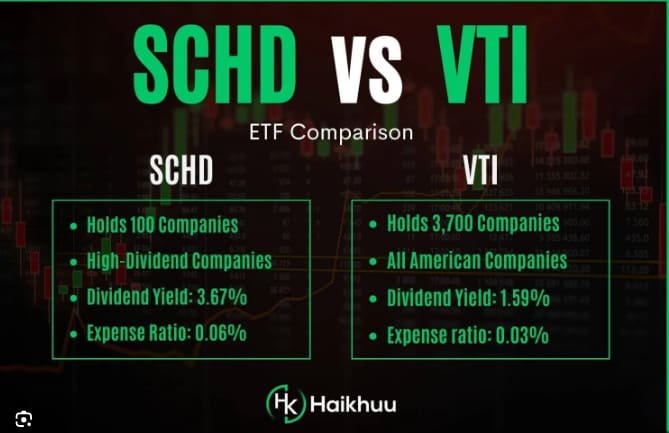
Editor’s Note: The choice between SCHD vs VTI hinges on your specific investment phase and tax strategy. VTI is the ultimate wealth-accumulation engine, offering unmatched diversification and capital appreciation across over 3,700 stocks, making it ideal for investors with a long time horizon. SCHD, conversely, acts as a cash-flow fortress, screening for 100 high-quality companies with consecutive dividend growth, making it perfect for those seeking psychological comfort and reliable income. Both boast ultra-low expense ratios, but your decision should align with whether you want to capture the entire market’s growth or build a passive income snowball.
Building a robust portfolio often leads investors to a fascinating crossroads: chasing the broad horizon of the entire US stock market or securing a predictable stream of dividend cash flow. When we look at the heavyweights in the ETF arena, the debate almost always boils down to Schwab US Dividend Equity ETF and Vanguard Total Stock Market ETF. You are essentially choosing between owning a slice of every publicly traded American company or carefully curating a vault of highly profitable, cash-generating enterprises.
This decision shapes not just your portfolio’s performance, but your psychological resilience during market volatility.
Understanding the Core Philosophies of SCHD vs VTI
To truly grasp the dynamic between these two financial titans, we must look under the hood at the underlying indices they meticulously track. The foundation of any exchange-traded fund dictates its behavior during both euphoric bull runs and terrifying bear markets.
- VTI operates on a passive, broad-net philosophy, capturing large-cap, mid-cap, and small-cap stocks without prejudice or complex filtering. It simply reflects the American economic machine in its entirety, allowing investors to ride the macroeconomic waves without worrying about picking the right sector or the right management team.
- On the opposite end of the spectrum, the Schwab US Dividend Equity ETF operates with a highly selective, almost ruthless screening mechanism. It tracks the Dow Jones U.S. Dividend 100 Index, which demands that companies not only pay dividends but possess the fundamental financial health to sustain them. This fund looks for ten consecutive years of dividend payments, robust cash flow to debt ratios, and high return on equity.
This fundamental difference in stock selection creates two entirely different investor experiences.
- 1- Holding VTI means accepting that your portfolio will be heavily weighted by the massive tech giants dominating the market cap landscape today. Your fortunes will rise and fall with the broader economic sentiment.
- 2- Holding SCHD, however, means anchoring your wealth in traditional, established sectors like financials, industrials, and consumer staples. These mature companies might not double in value overnight, but they consistently share their corporate profits directly with you, quarter after quarter, regardless of the stock price.
The Total Market Approach of Vanguard
Vanguard’s Total Stock Market ETF is the undisputed king of sheer diversification, boasting hundreds of billions in assets under management. By holding essentially every investable stock in the United States, it eliminates single-company risk and sector-specific implosions from your financial worries. If a small biotechnology firm suddenly invents a groundbreaking cure and skyrockets in value, VTI owners capture that upside automatically. You are buying the ultimate bet on the long-term ingenuity and expansion of the American economy, free from the stress of active stock picking.
However, this massive diversification also means you are buying the losers alongside the winners. You own the incredibly successful tech monopolies, but you also own struggling retail chains and fading legacy businesses. Because VTI is market-cap weighted, the largest companies still dictate the vast majority of its daily price movements. While the fund does pay a modest dividend, its primary objective is undeniably capital appreciation over decades. It is the quintessential set-it-and-forget-it wealth-building tool for investors willing to endure the market’s natural turbulence.
The Dividend Growth Strategy of Schwab
Schwab’s strategy revolves around the powerful concept of dividend growth, rather than just chasing the highest immediate yield. High-yield traps often catch novice investors who buy into failing companies that are desperately paying out cash they cannot afford. SCHD circumvents this by filtering for fundamental quality, ensuring that the 100 companies inside the vault have a proven history of increasing their payouts even during recessions. This means your personal income stream is designed to outpace inflation, organically growing year after year without requiring you to invest another dime.
This methodology naturally tilts the portfolio toward value stocks, stripping away the high-flying, speculative growth companies that dominate modern headlines. You will not find the latest artificial intelligence darling or electric vehicle startup inside this ETF. Instead, you are buying a collection of boring, highly profitable enterprises that sell toothpaste, beverages, and banking services. For an investor seeking a psychological anchor during market panic, seeing those cash deposits hit the brokerage account every three months provides a tangible reassurance that paper valuations simply cannot offer.
Analyzing Historical Performance and Total Return
When pitting SCHD vs VTI in a historical performance battle, the concept of total return must take center stage to ensure a fair fight. Total return calculates the growth of the ETF’s share price plus the reinvestment of all dividends paid out over that timeframe.
- Over the last decade, the broader market’s massive tech-driven bull run has generally given VTI a noticeable edge in sheer capital appreciation. The explosive growth of software and digital services propelled the total market index to unprecedented heights, leaving value-oriented funds somewhat behind in the headlines.
- However, SCHD has consistently proven to be a formidable contender, frequently beating the broader market during periods of high inflation or technological corrections. When speculative bubbles burst and growth stocks plummet, investors frantically rotate their capital into the safe haven of profitable, dividend-paying companies. During these painful market drawdowns, the Schwab ETF typically experiences a much shallower drop compared to the total market. The cash flow acts as a buffer, smoothing out the violent volatility and protecting the investor’s principal during extended periods of economic uncertainty.
The choice ultimately depends heavily on your psychological stamina and your investment timeline. A younger investor with three decades to endure market crashes might mathematically benefit more from the aggressive compounding of VTI’s growth stocks.
Conversely, an investor within a decade of retirement might willingly trade a few percentage points of maximum potential growth for the sleep-well-at-night stability that SCHD provides. Historical data confirms that both funds are exceptional wealth-building instruments, but they achieve their impressive results through entirely different behavioral mechanics.
Risk Tolerance and Market Drawdowns
Understanding your true risk tolerance is often a painful lesson learned only during a severe market crash. When VTI drops twenty percent, it tests the conviction of even the most seasoned passive investors. Because it holds thousands of companies, it absorbs the full, unfiltered impact of
- macroeconomic panic,
- interest rate shocks and
- global crises.
If seeing your portfolio value shrink drastically causes you to lose sleep or consider panic-selling, the unhedged exposure of a total market fund might not align with your actual psychological profile.
The dividend growth strategy inherently provides a psychological armor that prevents catastrophic investor behavior. When SCHD experiences a drawdown, the share price might fall, but the underlying high-quality companies typically maintain or even raise their dividend payouts.
Investors focused on income see market crashes as an opportunity; lower share prices mean their reinvested dividends are acquiring new shares at a steep discount, locking in a higher starting yield. This shift in perspective transforms market fear into a strategic advantage, keeping investors disciplined during turbulent times.
Portfolio Construction and Tax Efficiency
Integrating these funds into a broader portfolio requires a strategic understanding of asset allocation and the silent wealth-killer known as taxes. Holding both SCHD vs VTI is not a crime, and many investors successfully blend the two to create a customized core and satellite strategy. You could use the Vanguard fund as your primary growth engine, capturing the total market’s momentum, while allocating a smaller percentage to the Schwab ETF to dampen volatility and generate a rising floor of passive income. This hybrid approach offers a balanced psychological ride.
- However, the location of these assets across your various brokerage accounts is absolutely critical to maximizing your long-term returns. Dividends, while psychologically comforting, create an immediate tax drag if held in a standard taxable brokerage account. Every time SCHD pays you cash, the government demands a cut, reducing the total amount of capital you have working for you. Because this ETF focuses heavily on high yields, it is highly recommended to shelter it inside tax-advantaged accounts like an IRA, protecting the compounding snowball from annual taxation.
- VTI, on the other hand, is renowned for its incredible tax efficiency, making it the perfect candidate for a standard taxable account. Because its dividend yield is relatively low and Vanguard utilizes a unique structure to manage capital gains distributions, it generates very little tax friction year over year. You control when you pay taxes by deciding exactly when to sell your shares. Mastering this asset location strategy ensures that you are keeping the maximum amount of your wealth, regardless of which investment philosophy you ultimately favor.
Designing Your Personal Wealth Strategy
Building a truly resilient financial future means looking past the endless debates and acknowledging that both of these exchange-traded funds are monumental achievements in modern investing. Your choice should not be driven by internet hype, but by a brutally honest assessment of your financial goals and your emotional reactions to market red days. If you crave ultimate diversification, demand tax efficiency, and have decades to let compounding work its magic, VTI provides an unbeatable, frictionless path to long-term wealth accumulation.
Conversely, if you prioritize tangible cash flow, value the stability of mature enterprises, and want a portfolio that pays you directly without forcing you to sell off your assets, SCHD is a masterclass in dividend growth. The ultimate financial blueprint often lies in understanding that there is no perfect universal portfolio, only the portfolio you can confidently stick with during a severe recession.
By aligning your investments with your personal temperament, you secure not just your wealth, but your enduring peace of mind.