

Editor’s Note: For most retail investors navigating turbulent times, Dollar-Cost Averaging (DCA) is the best approach for volatile Western markets because it systematically lowers the psychological barrier to entry and mitigates sequence of returns risk, even though Lump Sum Investing (LSI) historically offers higher mathematical returns during long-term bull runs. When the S&P 500 or Nasdaq 100 experiences jagged price swings driven by shifting Federal Reserve policies or geopolitical tension, the emotional toll of “buying the top” can lead to catastrophic panic selling. By breaking your capital into smaller, periodic installments, you effectively weaponize volatility to lower your average cost basis over time.
Choosing between these two heavyweight strategies isn’t just a math problem; it’s a masterclass in behavioral finance and risk tolerance. While the “smart money” often advocates for immediate market exposure to capture the equity risk premium, the reality is that Western markets are currently facing unprecedented structural shifts and interest rate sensitivity.

At Usmarketinvesting.com, we lean toward the Blue Ocean philosophy of minimizing emotional friction—if a strategy keeps you in the game during a 20% drawdown, it is inherently superior to a “perfect” paper strategy that you abandon at the first sign of trouble.
The Mathematical Dominance of Lump Sum Investing
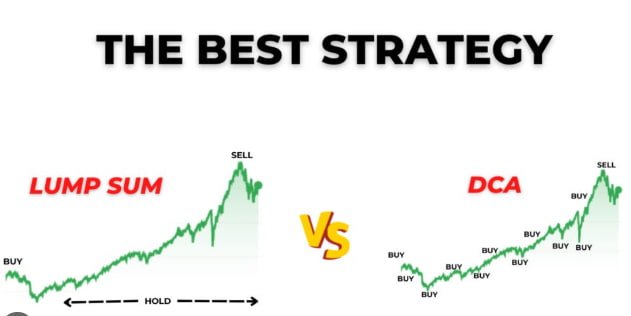
Historically, Lump Sum Investing has outperformed DCA approximately 66% of the time because markets spend more time trending upward than downward, allowing your capital to benefit from compound interest immediately. When you deposit a large amount of cash into the market at once, you are maximizing your “time in the market,” which is the single most important factor in long-term wealth creation according to decades of Vanguard research. In a market characterized by long-term growth, waiting to invest means you are missing out on dividends and the natural appreciation of blue-chip equities and broad-market ETFs.
However, the primary risk of the Lump Sum approach is the dreaded market timing error—investing your entire life savings just days before a major correction or a black swan event. For an investor in Western markets, where valuations can stay stretched for years before a mean reversion, the “all-in” move requires a stomach of steel and a very long investment horizon.
If you have the psychological fortitude to ignore a 10% drop next week, the math suggests that putting your money to work right now is statistically the most efficient way to capture the market’s total return.

Despite its mathematical edge, Lump Sum investing can be a trap for those without a clear exit strategy or those nearing retirement. The impact of a significant loss immediately after a large investment—known as negative sequence risk—can be devastating to a portfolio’s recovery time.
The Psychological Shield of Dollar-Cost Averaging
Why do seasoned professionals often suggest Dollar-Cost Averaging as the best approach for volatile conditions even when the math is slightly less optimal?
The answer lies in the reduction of investor regret and the automation of discipline; it turns market dips into “buying opportunities” rather than “portfolio tragedies.” When prices fall, your fixed monthly contribution automatically buys more shares, effectively lowering your break-even point and ensuring that you don’t chase rallies or flee during panics.
In the current landscape of high-frequency trading and algorithmic volatility, DCA serves as a vital risk management tool that smooths out the peaks and valleys of your entry price. Instead of agonizing over whether the Fed will hike rates or if a tech bubble is bursting, you simply stay consistent with your automated investment plan.
This consistency is the bedrock of wealth accumulation for the average investor, as it replaces emotional decision-making with a cold, calculated routine. By prioritizing mental peace and long-term participation, DCA often leads to better “real-world” outcomes because the investor is far less likely to quit during a bear market.
Navigating Volatility in Western Markets
Western markets, particularly the US stock exchanges, have entered an era of regime change where low-inflation certainty has been replaced by macro-economic instability and rapid sector rotations. In this environment, the best approach for volatile indices is one that acknowledges the high probability of a “sideways” market or a prolonged period of consolidation. When the market moves in a range-bound fashion, DCA shines by allowing you to accumulate a larger position at lower prices during the inevitable “fake-outs” and pullbacks.
This volatility harvesting technique is especially effective in growth-heavy sectors like AI and renewable energy, where price discovery is still ongoing and daily swings can be massive.
Furthermore, Western investors must account for geopolitical risk and the impact of domestic fiscal policy on currency strength, both of which can cause sudden, sharp market resets. A Lump Sum investment made during a period of peak optimism can take years to recover if a sudden shift in global trade occurs shortly after. Conversely, the DCA investor views these shifts as a necessary part of the market cycle, continuing their contributions and benefit from the “rebound” without having to guess when it will happen.
The strategic choice between DCA and LSI also depends heavily on the specific asset classes you are targeting within your portfolio. For highly liquid, broad-market instruments like the S&P 500 (SPY) or Total Stock Market (VTI) ETFs, the historical data strongly supports the Lump Sum approach for those who can handle the ride.

Analyzing Strategy Outcomes: DCA vs. Lump Sum
When we look at the historical data across different market cycles, including the 2008 financial crisis and the 2020 pandemic crash, we see clear patterns in how these strategies perform under pressure. While LSI captures more of the upside in a “melt-up” scenario, DCA provides a much-needed downside buffer during prolonged “U-shaped” recoveries. This is also important for searching for best approach for volatile markets.
Choosing the best approach for volatile periods requires an honest assessment of your cash flow; do you have a “windfall” ready to deploy, or are you investing from your monthly salary?
The table below provides a side-by-side comparison of how these strategies react to specific market conditions common in Western economies.
| Investment Feature | Lump Sum Investing (LSI) | Dollar-Cost Averaging (DCA) | Best For… |
| Market Exposure | Immediate and 100% maximized. | Gradual and risk-managed. | LSI for Bull Markets |
| Psychological Stress | Very High (Fear of buying the top). | Low (Market dips are welcomed). | DCA for Volatile Markets |
| Historical Return | Higher in 2/3 of historical cases. | Lower, but with less variance. | LSI for Long-Term Growth |
| Complexity | Simple, one-time transaction. | Requires ongoing discipline/automation. | DCA for Monthly Savers |
| Risk Mitigation | Vulnerable to “Sequence Risk.” | Mitigates “Timing Risk” effectively. | DCA for Risk-Averse |

Strategic Implementation and Portfolio Shielding
To implement the best approach for volatile markets effectively, you should consider a “Hybrid Model” that combines the strengths of both LSI and DCA to suit your specific risk profile.
For example, if you receive a large bonus or inheritance, you might choose to invest 50% as a Lump Sum immediately to establish a core position, while trickling the remaining 50% into the market over the next 6 to 12 months. This balanced strategy ensures you don’t miss out on a potential rally while still keeping “dry powder” on the sidelines to capitalize on any sudden market corrections. This flexibility is the hallmark of a sophisticated investor who understands that the market doesn’t care about your “perfect” plan.
Implementing an automated investment schedule is the final piece of the puzzle, as it removes the burden of manual execution and the temptation to skip a month when the news cycle looks grim. Most modern brokerage platforms in Western markets offer seamless DCA tools that allow you to set your contribution amount and frequency with just a few clicks.
This “set it and forget it” mentality is often the most powerful wealth-building habit you can develop, as it prevents you from becoming your own worst enemy. By automating your strategy, you ensure that your financial goals remain on track regardless of whether the headlines are screaming about a recession or a new all-time high.
Finally, always keep an eye on transaction costs and tax implications, especially if you are investing in a taxable brokerage account rather than a tax-advantaged retirement plan like a 404(k) or IRA.

FAQ: Tips for Investing in Volatile Markets
Investors often have pressing questions about how to handle their capital when the “fear gauge” (VIX) starts to rise and the headlines become increasingly bearish. Understanding the nuances of the best approach for volatile conditions can mean the difference between staying the course and making a life-altering financial mistake.
We’ve compiled the most common inquiries from our community to help you navigate the DCA vs. Lump Sum debate with a clear, data-driven perspective. These answers are designed to provide immediate clarity so you can act with confidence in any market environment.
Check out these expert insights to help you finalize your entry strategy and protect your capital:
- Is DCA better during a recession? Yes, DCA is often the preferred strategy during a recession because it allows you to buy more shares as prices fall, significantly lowering your average cost by the time the recovery begins.
- Should I stop DCA if the market is crashing? Absolutely not; stopping your contributions during a crash is the most common way investors “lock in” their losses and miss out on the most profitable days of the eventual market rebound.
- What is the ideal timeframe for a DCA schedule? Most experts recommend a period of 6 to 12 months for deploying a large sum of cash, as this covers enough time to smooth out typical short-term volatility.

Master Market’s Rhythm: Approach for Volatile Markets
Whether you choose the calculated aggression of Lump Sum Investing or the steady, disciplined path of Dollar-Cost Averaging, the most important factor is that you actually start and stay invested. The best approach for volatile Western markets is ultimately the one that aligns with your unique psychological makeup and allows you to sleep soundly at night while your capital works for you.
Volatility is not something to be feared; it is a fundamental characteristic of high-return markets that provides the very “discount” opportunities that lead to long-term financial independence. By mastering your entry strategy, you are taking control of your financial destiny in an increasingly unpredictable world.
Take a hard look at your current “dry powder” and your monthly cash flow to decide which path makes the most sense for you today. Remember, even a “sub-optimal” strategy that you stick to for twenty years will vastly outperform a “perfect” strategy that you only follow for twenty weeks.
Western markets have historically rewarded those with the patience to endure the noise and the discipline to keep buying when others are selling.