
Editor’s pick: Setting up an offshore holding company us stocks structure in the British Virgin Islands (BVI) or Cayman Islands shields Non-Resident Aliens from the 40% US Estate Tax, but annual fees and a 30% dividend tax make it inefficient for portfolios under $2,000,000.
When global investors build substantial wealth in equities like Apple, Nvidia, or S&P 500 ETFs (SPY and IVV), the $60,000 estate tax cliff becomes an urgent threat. Historically, wealthy foreign families solved this by forming corporate blockers in zero-tax jurisdictions.
Real Life Experience from Investors
While incorporating a Personal Investment Company (PIC) sounds sophisticated, modern investors must weigh that legal protection against operational friction.
Opening a corporate brokerage account at Interactive Brokers or Charles Schwab International requires extensive compliance paperwork, annual registered agent fees, and Legal Entity Identifier (LEI) renewals.
Furthermore, moving your portfolio from a personal account into a BVI or Cayman entity forfeits the bilateral tax treaty benefits you previously enjoyed as an individual resident.
Before paying thousands of dollars to corporate service providers, you need a transparent breakdown of when a corporate blocker makes mathematical sense.

Financial experts note that for most Non-Resident Aliens, buying Ireland-domiciled UCITS ETFs in a personal account achieves the exact same estate tax immunity at a fraction of the cost.Below, we deconstruct how Caribbean holding companies interact with the Internal Revenue Service and when your capital justifies a corporate wrapper.
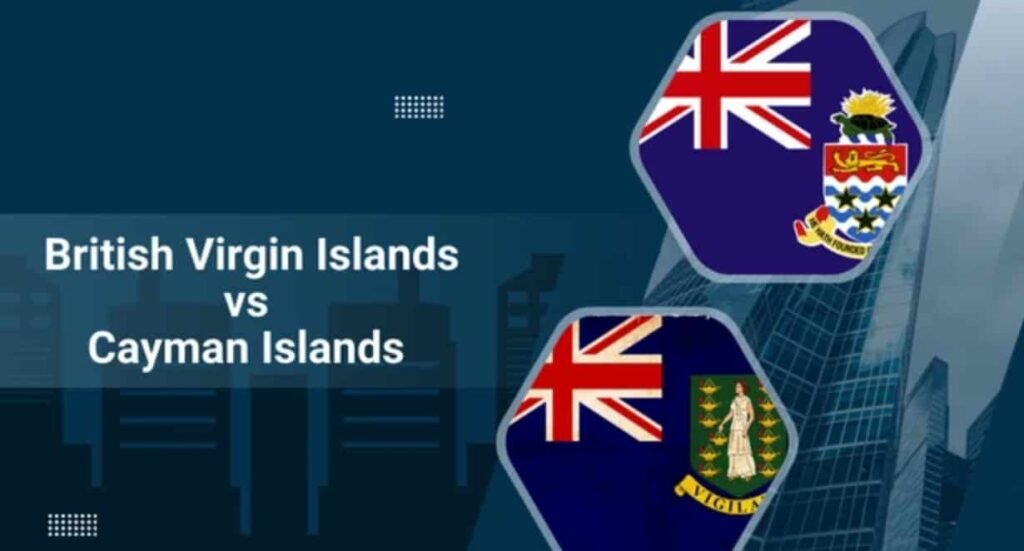
Why Foreign Investors Use BVI & Cayman
The primary motivation behind an offshore holding company us stocks strategy is neutralizing United States situs exposure upon death.
Under the Internal Revenue Code, a Non-Resident Alien who personally owns shares of Microsoft, Tesla, or US-domiciled funds like QQQ and VOO faces up to a 40% federal estate tax on balances exceeding $60,000.
However, when a BVI Business Company or Cayman Exempted Company buys those securities, the foreign corporation legally owns the US-situs shares.
Because a corporation never dies—and shares of a foreign company situated in the British Virgin Islands or the Cayman Islands are classified as non-US situs property—passing the holding company shares to your heirs does not trigger Form 706-NA or an IRS account freeze.

Caribbean Corporate Vehicles and Families
Additionally, Caribbean corporate vehicles offer streamlined succession planning for international families living in jurisdictions with rigid forced-heirship laws, allowing share transfers to bypass slow cross-border probate courts entirely.
Furthermore, zero-tax offshore jurisdictions impose no local corporate income tax, no capital gains tax, and no local withholding tax when profits are distributed to the shareholder.
Since the Internal Revenue Service also exempts foreign corporations from US capital gains tax on passive stock trading, capital appreciation compounds in United States Dollars without a second layer of corporate taxation.
This clean pass-through structure explains why ultra-high-net-worth investors holding individual US stocks still utilize BVI and Cayman entities.

Hidden Offshore Costs: W-8BEN-E & Tax
Despite the estate protection, operating an offshore corporation introduces tax and compliance penalties that catch retail investors off guard.
Neither the British Virgin Islands nor the Cayman Islands has an income tax treaty with the United States. If you live in a treaty country like the United Kingdom, Canada, or Germany, holding US stocks personally with Form W-8BEN lowers your dividend tax from 30% to 15%.
Moving those stocks into a BVI company requires Form W-8BEN-E, locking in the 30% dividend tax.
Beyond the thirty percent dividend tax drag, maintaining a corporate brokerage account involves recurring expenses that erode smaller portfolios. Before incorporating an offshore blocker, international investors must account for these annual obligations:
- Incorporation and Agent Fees: Expect to pay $1,500 to $3,000 upfront and $1,200 to $2,500 annually for registered maintenance.
- Form W-8BEN-E Compliance: Classify the entity as a Passive NFFE and disclose all Controlling Persons.
- LEI and Exchange Fees: Corporate accounts require an active Legal Entity Identifier (LEI) and pay higher data rates.
| Feature | Personal Account | BVI / Cayman Co. | Ireland UCITS ETF |
|---|---|---|---|
| IRS Form | Form W-8BEN | Form W-8BEN-E | Form W-8BEN |
| Dividend Tax | 15%–30% (Treaty) | 30% (No Treaty) | 15% Internal |
| Estate Tax | Yes (>$60,000) | No (0% Exempt) | No (0% Exempt) |
| Annual Cost | $0 Maintenance | $1,500–$3,000+ | 0.07%–0.33% Fee |
| Ideal Size | Under $60,000 | Over $2,000,000 | $60k–$2,000,000+ |
When a Corporate Blocker Beats Ireland-Domiciled UCITS ETFs
If an Ireland-domiciled UCITS ETF like CSPX or VWRA eliminates the US Estate Tax and secures a 15% dividend tax rate inside a free personal account, why would anyone pay for a BVI company? The answer lies in asset selection.
UCITS funds only wrap broad indices like the S&P 500 or Nasdaq-100; they do not help if you want to hold a multi-million-dollar portfolio of individual American stocks like NVDA, AMZN, or BRK.B, or trade US equity options.
Historical data suggests that once an individual US stock portfolio exceeds $1,500,000 to $2,000,000, the annual $2,000 BVI maintenance fee shrinks to 0.10% of total assets—comparable to a standard ETF expense ratio.
Moreover,if your portfolio focuses on zero-dividend growth stocks like Berkshire Hathaway or high-growth tech companies, the lack of a US tax treaty in the Cayman Islands or BVI costs you nothing in extra dividend withholding while saving your heirs substantial estate taxes.

The Hidden Risks in International Investing
Operating a cross-border investment structure requires managing invisible hazards that go beyond registration fees.
- First, Tax Withholding remains a major drag inside a BVI or Cayman entity; paying a 30% IRS tax on high-yielding US value stocks or dividend ETFs like SCHD and VYM blunts long-term compounding.
- Second, investors who abandon offshore companies in favor of European UCITS funds must monitor Tracking Error, as swap fees and cash drag can cause offshore index funds to trail US benchmarks.
- Third, trading through a leveraged corporate brokerage account exposes your capital to severe Margin Risk. During sharp market sell-offs triggered by Federal Reserve interest rate hikes, brokerages liquidate margined positions automatically without waiting for corporate board resolutions or wire transfers.
Worse still, many home countries enforce strict Controlled Foreign Corporation (CFC) rules. Always consult with a tax professional locally, because if your domestic tax agency deems your BVI company to be managed from home, they may tax it domestically.

Frequently Asked Questions
What is the difference between Form W-8BEN and Form W-8BEN-E for an offshore company?
Form W-8BEN is a one-page certificate signed by individual Non-Resident Aliens, whereas Form W-8BEN-E is an eight-page compliance document required for foreign corporations, trusts and partnerships.
When opening a brokerage account for a BVI or Cayman company, you must complete Form W-8BEN-E and select the “Passive NFFE” status, certifying that over 50% of the entity’s income comes from passive dividends and capital gains.
Does the IRS look through a BVI company and apply the US Estate Tax anyway?
As long as your BVI or Cayman company is properly incorporated, maintains legal standing by paying its annual registry fees, and holds securities in a dedicated corporate brokerage account, the Internal Revenue Service respects its corporate identity.
However, if you commingle personal and corporate funds, fail to keep corporate records, or use a revocable trust instead of a corporation, the IRS can challenge the structure.
Why do US brokers charge higher market data fees to BVI holding companies?
Exchanges like the NYSE and Nasdaq classify account holders as either “Non-Professional” (retail individuals) or “Professional” (corporations and institutions).
Even if your BVI or Cayman company is a one-person family investment vehicle, stock exchanges automatically categorize any corporate account as a Professional subscriber. Consequently, live market data subscriptions that cost $1 to $5 monthly in a personal account jump to over $100 monthly inside a corporate account.

Choosing the Right Legal Wrapper
Deciding whether to implement an offshore holding company us stocks structure comes down to portfolio math and your investment style. If you are a passive index investor building wealth below two million dollars, forming a BVI or Cayman company is financial overkill that drains returns through annual agent fees and a 30% dividend tax.
Transitioning your personal brokerage holdings into Ireland-domiciled accumulating UCITS ETFs gives you complete immunity from the 40% US Estate Tax without spending a dollar on corporate lawyers.
Conversely, if you manage a multi-million-dollar portfolio of individual American growth stocks, pre-IPO shares, or active options strategies that cannot be replicated via UCITS funds, a Caribbean corporate blocker remains a powerful wealth-preservation tool.
Audit your current US-situs exposure today, compare your annual dividend yield against corporate maintenance costs, and verify your home country’s Controlled Foreign Corporation rules before signing incorporation papers so your global wealth compounds safely.