If you’ve been holding onto your shares through the volatility of the last few years, you’re probably asking yourself one burning question: Is Google stock still the “forever hold” we all thought it was? It is 2026, and the tech landscape has shifted dramatically. The AI wars that kicked off in the early 2020s have settled into a new normal, and Alphabet isn’t just a search engine company anymore; it’s an AI-first conglomerate fighting to keep its crown.
For years, buying Google stock was as close to a “no-brainer” as you could get in the stock market. But with aggressive competition from nimble startups and legacy rivals like Microsoft, the moat around Google’s castle has been tested like never before. We aren’t just looking at quarterly earnings here; we are looking at the soul of the company. Has Alphabet successfully pivoted to dominate the generative AI era, or is it weighed down by its own massive size?
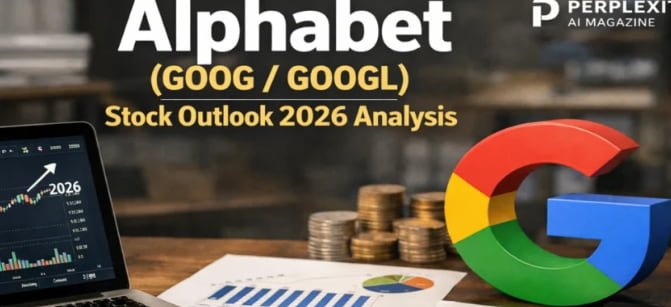
In this article, we are going to strip away the Wall Street jargon and look at what actually matters for your portfolio. We will analyze the health of their ad revenue, the explosion of Google Cloud, and the regulatory headaches that just won’t go away. Whether you are looking to buy the dip or wondering if it’s time to take profits, this Google stock analysis for 2026 covers the good, the bad, and the profitable.
The AI Verdict: Has Gemini Finally Paid Off?
Let’s address the elephant in the server room: Artificial Intelligence. Back in 2024, everyone was worried that ChatGPT was going to kill Google Search. Fast forward to 2026, and we can see that Google stock didn’t collapse; instead, the company integrated AI into every pixel of its ecosystem. The “Search Generative Experience” (SGE) is no longer an experiment; it is the standard. Google managed to defend its territory by making search smarter, not obsolete, proving that their massive data advantage was the ultimate trump card.
However, the cost of this victory has been astronomical. Running these heavy AI models requires a level of capital expenditure (CapEx) that would bankrupt smaller nations. For investors, the question has shifted from “Will AI kill Google?” to “Can Alphabet make AI profitable enough to justify the spending?” The integration of Gemini into Workspace and Android has created new revenue streams, but margins have been squeezed. The market has largely priced this in, understanding that this was a necessary survival cost to keep the Google stock price trajectory pointing up.
The real win for Alphabet in 2026 isn’t just a chatbot; it’s the infrastructure. By controlling the custom silicon (TPUs) and the models, it has insulated itself from reliance on hardware providers like Nvidia more than its competitors have. This vertical integration is the hidden gem in the Google stock narrative. While others are paying a premium for compute power, Google is optimizing its own house, which suggests better long-term margins as the AI hype cycle matures into utility.
Monetizing the AI Assistant
The most exciting development for Google stock holders in 2026 is the successful monetization of the personal AI assistant. It’s no longer just about asking for the weather; it’s about a subscription model that integrates your life. Google has effectively up-sold millions of users from free tiers to premium AI tiers within the Google One ecosystem.
This recurring revenue bundle is a massive stabilizer for the stock. It reduces the company’s reliance on ad revenue, which can be cyclical and sensitive to economic downturns. When you analyze the valuation of GOOGL stock, you have to factor in this sticky, high-margin subscription revenue that didn’t exist at this scale just a few years ago.

The Search Ads Evolution
There was a fear that AI answers would mean nobody clicks on ads anymore. That fear turned out to be overblown. It found a way to weave “sponsored” AI suggestions naturally into conversation flows. The ad machinery didn’t break; it just evolved.
For GOOGL, this is critical because search ads are still the engine of the ship. Advertisers have found that AI-driven intent matching actually converts better than old-school keyword targeting. As long as Google controls the gateway to the internet’s information, their ad printer will keep going well.
Google Cloud: No Longer the Underdog
For a decade, Google Cloud Platform (GCP) was the distant third horse in a race dominated by Amazon (AWS) and Microsoft (Azure). In 2026, the narrative has shifted. GCP is finally a massive profit driver, contributing significantly to the GOOGL stock bottom line. The reason for this surge isn’t just cheap storage; it’s the AI stack. Enterprise clients flocked to Cloud because it offered the most seamless integration for building their own AI applications using Vertex AI.
We are seeing a “flywheel effect” here. Companies that use G Workspace are naturally migrating to G Cloud for their backend needs, creating a locked-in ecosystem that is incredibly hard to leave. This stickiness is exactly what value investors love to see. It transforms Google stock from a cyclical ad play into a secular growth story in the enterprise software space. The operating margins for the cloud division have finally expanded to a point where they are moving the needle on earnings per share (EPS).
However, the competition hasn’t slept. Microsoft is still a formidable foe, and the cloud wars have turned into a price war in some sectors. But Google’s specific focus on data analytics and machine learning gave them a niche that became the whole market. If you are holding GOOGL stock, you should be cheering every time you hear about a new Fortune 500 company signing a multi-year cloud deal with Alphabet.

Enterprise AI Adoption
The corporate world was slow to trust AI with their proprietary data, but Google solved that trust gap faster than most. By offering “walled garden” AI environments within the cloud, they captured the banking and healthcare sectors. This is high-value, low-churn revenue.
This segment is growing faster than the core search business. For the GOOGL valuation, this means we can start assigning a higher multiple to this portion of the revenue. It’s not just “other bets” anymore; it’s a pillar of the company.
The Profitability Turnaround
Remember when G Cloud was losing billions? Those days are a distant memory. In 2026, the cloud division is a cash flow positive beast. This profitability shift has allowed Alphabet to continue its aggressive stock buyback program without dipping into cash reserves needed for R&D.
When analyzing Google stock, the cloud profitability provides a safety net. Even if ad spend slows down due to a recession, the recurring revenue from cloud contracts keeps the cash flow predictable and robust.
YouTube: The New King of Television
YouTube isn’t just a video site; in 2026, it is effectively the biggest television network in the world. The shift of ad dollars from linear TV to Connected TV (CTV) has benefited YouTube disproportionately. For Google stock, YouTube is the bridge to the younger generation (Gen Z and Alpha) who don’t even know what a cable subscription is. The explosion of YouTube Shorts has also finally been monetized effectively, closing the gap with TikTok and keeping users inside the Google ecosystem.
The subscription model, YouTube Premium, has also seen impressive retention. People hate ads, and they are willing to pay to avoid them. This dual-engine revenue model (ads + subscriptions) makes YouTube a unique asset that no other tech giant really has. Apple has TV+, Amazon has Prime Video, but neither has the user-generated content volume and the search intent data that YouTube provides. This unique position strengthens the bull case for Google stock.
However, content costs are rising. To keep top creators from defecting to other platforms, it has to pay out significant revenue shares. While this impacts gross margins, it is a necessary expense to maintain dominance. As long as the engagement metrics—time spent on platform—keep rising, the stock will be rewarded.
The “Shorts” Monetization Puzzle
It took a while, but Google finally figured out how to make money on short-form video. In 2026, advertisers are pouring money into Shorts because the conversion tracking is superior to competitors. This opened up a new inventory of ad space that didn’t exist five years ago.
For Google stock, this was essential. If they had lost the short-form war, they would have lost the future attention span of the internet. Winning here proves that the old dog can learn new tricks and adapt to changing consumer behaviors.
Regulatory Risks: The Sword of Damocles
We cannot talk about Google stock analysis without talking about the Department of Justice (DOJ) and the European Union. In 2026, the regulatory pressure hasn’t vanished; it has just become part of the operating cost. The breakup of the company—a threat that loomed large in 2024—seems less likely to happen in a way that destroys shareholder value, but the fines and restrictions are real. Alphabet has been forced to open up its ad-tech stack and allow for more third-party payment options in the Play Store.
Investors have largely become desensitized to the headlines. The market has realized that even if Google is forced to spin off certain divisions, the sum of the parts might actually be worth more than the whole. However, these legal battles are a constant drag on the P/E ratio. Google stock often trades at a discount compared to its peers like Microsoft or Apple simply because of this regulatory overhang.
The “Google Tax” on the internet is being challenged, and margins on the App Store are compressing. This is the single biggest headwind for the stock. If you are investing in 2026, you have to be comfortable with the fact that Google will be in courtrooms for the next decade. It’s the price of dominance.
Conclusion: Is Google still a Buy?
So, where does that leave us with Google stock in 2026? Alphabet is a company in transition, but it is a transition from strength to strength. They survived the initial AI panic, they turned the Cloud division into a profit engine, and they maintained their stranglehold on digital advertising. The company is a cash-generating machine with a balance sheet that is the envy of the corporate world.
However, the days of easy, hyper-growth are likely behind us. This is now a “mature compounder.” You buy Google stock today not because you expect it to double in six months, but because it offers a balance of safety and growth that is hard to find elsewhere. It is the blue-chip stock of the digital age.
If you are a long-term investor, the valuation in 2026 likely looks attractive compared to the inflated multiples of pure-play AI stocks. The risks are there—specifically from regulators—but the moat is wide. As long as the world searches for answers, Google stock deserves a place in your portfolio.