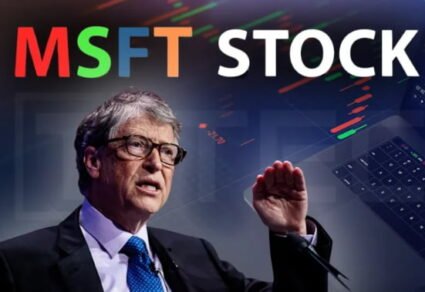
For decades, Microsoft was viewed as the “safe but boring” choice in the tech sector—the company you bought for stability while you looked elsewhere for explosive growth. However, as we settle into 2026, that narrative has been completely rewritten. Microsoft Stock has evolved into a unique hybrid: a massive, stability-focused blue-chip company that is growing with the ferocity of a startup. Under Satya Nadella’s continued leadership, the company has successfully pivoted from being just an operating system provider to becoming the “operating system of the world’s AI infrastructure.”
The investment thesis for Microsoft today is fundamentally different than it was five years ago. We are no longer just counting PC sales; we are looking at how deeply entrenched the Microsoft ecosystem is in the global economy. From the Azure cloud backbone running Fortune 500 companies to the AI “Copilots” assisting every office worker, the company has built a moat so wide it seems almost impossible to cross. But with the stock trading at historically high valuations, investors are right to ask: Is there any upside left, or is the perfect scenario already priced in?

In this analysis, we will strip away the hype and look at the engines driving the company forward. We will examine the maturity of their AI investments, the durability of their cloud revenue, and the often-overlooked gaming division. Equally important, we will shine a light on the regulatory and competitive risks that could derail this freight train. Whether you are holding MSFT for the long haul or considering an entry point in 2026, this breakdown is designed to give you the clarity you need.
Azure: The Cloud Computing Juggernaut
When analyzing Microsoft Stock, the conversation must start with Azure. In 2026, cloud computing has transitioned from a “nice-to-have” digital upgrade to an essential utility, much like electricity. Azure has successfully closed the gap with Amazon’s AWS, becoming the preferred choice for enterprise clients. The reason is simple: integration. For a company already using Windows, Teams, and Office, moving to Azure is the path of least resistance. This “ecosystem lock-in” ensures that revenue continues to flow even when the broader economy faces headwinds.
However, the story in 2026 isn’t just about storage and computing power; it is about the “AI Layer.” Azure is no longer just selling server space; it is selling the infrastructure required to run complex AI models. Companies building their own internal AI tools are increasingly building them on top of Azure because of Microsoft’s exclusive partnership with OpenAI. This has given Microsoft a significant pricing power advantage. They aren’t just competing on price anymore; they are competing on capability, allowing them to maintain healthy profit margins even as the market matures.
Yet, we must remain realistic about growth rates. The law of large numbers eventually kicks in. Azure cannot grow at 50% forever when it is already generating tens of billions in quarterly revenue. Investors need to watch the “optimization” trends. In 2026, many corporate clients are looking to cut costs, optimizing their cloud spend rather than expanding it blindly. While Azure’s revenue is “sticky,” the explosive growth phase is likely transitioning into a “steady, high-yield” phase, which naturally impacts how the market values the stock.
The “Copilot” Era: Monetizing Productivity
The most bullish argument for Microsoft Stock right now is the successful monetization of AI through “Copilot.” Two years ago, there was skepticism about whether businesses would pay an extra premium per user for AI features in Word, Excel, and PowerPoint. Today, the data answers that question with a resounding “yes.” For enterprise clients, Copilot has become non-negotiable. It has fundamentally changed the value proposition of the Microsoft 365 suite, moving it from a standard productivity tool to an active business assistant that writes code, summarizes meetings, and analyzes data.
This shift has done wonders for the Average Revenue Per User (ARPU). In the past, Microsoft could only raise prices incrementally. Now, by upselling AI capabilities, they have unlocked a new tier of revenue without needing to acquire a single new customer. They are simply mining more value from their existing massive user base. This is the holy grail of SaaS (Software as a Service) economics. The integration of AI has revitalized “legacy” products, making Excel and Outlook exciting again, which is a marketing feat in itself.

However, the dependency on AI also brings a dependency on hardware. Running these Copilot models is incredibly expensive in terms of computing power and energy. Microsoft’s capital expenditure (CapEx) has ballooned to support the data centers required for this AI revolution. Investors need to keep a close eye on the profit margins. While revenue is soaring, the cost of generating that revenue is also higher than in the traditional software era. The company needs to prove that the efficiency gains from AI eventually outweigh the massive infrastructure costs required to run it.
Gaming and the Metaverse: The Consumer Play
While enterprise software pays the bills, Microsoft’s gaming division remains its most potent connection to the consumer market. Following the full integration of Activision Blizzard, Microsoft now owns some of the most valuable intellectual property in gaming history, from Call of Duty to Candy Crush. In 2026, the strategy has shifted away from selling Xbox consoles to selling “Game Pass” subscriptions. They are building the “Netflix of Gaming,” where the screen you play on—be it a TV, PC, or phone—matters less than the subscription you pay for.
This diversification is critical for Microsoft Stock because it provides a buffer against B2B (business-to-business) cycles. Even if corporate spending slows down, consumer entertainment often remains resilient. The acquisition of mobile gaming giants has finally given Microsoft a foothold in the smartphone market, an area where they had historically failed. By controlling the content, Microsoft has insulated itself from the platform wars, ensuring they make money regardless of whether a gamer is using an iPhone or an Android device.
Despite the potential, gaming is a hit-driven business with thin margins compared to software. Developing AAA game titles costs hundreds of millions of dollars and takes years. There is always a risk that a slate of bad game releases could drag down sentiment. Furthermore, the “cloud gaming” vision is still battling latency issues and internet infrastructure limitations globally. While it is a strong growth pillar, it requires constant heavy investment and creative success, which is harder to predict than recurring software contracts.

Financial Fortress: Dividends and Cash Flow
For the conservative investor, the balance sheet is the most attractive part of the Microsoft Stock analysis. The company sits on a mountain of cash that rivals the GDP of small nations. This financial fortress allows Microsoft to weather any economic storm, acquire competitors, and invest in R&D without taking on dangerous levels of debt. In a high-interest-rate environment, this self-sufficiency is a massive premium.
Moreover, Microsoft continues to return capital to shareholders aggressively. While it is not a high-yield dividend stock compared to utilities or REITs, its dividend growth rate is consistent and reliable. Coupled with massive share buyback programs, Microsoft creates a “floor” for its stock price. Even when the stock market sells off, the company is often there buying its own shares, which supports the Earnings Per Share (EPS) and gives investors peace of mind.
Valuation Concerns: Is It Priced for Perfection?
The elephant in the room for Microsoft Stock in 2026 is valuation. The market knows everything we just discussed—the AI dominance, the cloud growth, and the cash flow. As a result, the stock is priced for perfection. It trades at a premium P/E (Price-to-Earnings) multiple compared to the broader S&P 500. (think about Apple) This implies that Wall Street expects flawless execution for the next five years.
When a stock is priced this high, any small stumble—a slight miss in Azure growth or a delay in a product launch—can lead to a disproportionate sell-off. This is called “multiple compression.” Investors aren’t necessarily worried that Microsoft will fail; they are worried that the stock price has gotten too far ahead of the actual earnings. Buying at these levels requires a belief that the AI boom is in its early innings, not its peak.

Major Risks: Regulation and “AI Fatigue”
No analysis is complete without looking at the bear case and for Microsoft stock, the biggest threat comes from regulators. Governments in the US, Europe, and the UK are increasingly hostile toward “Big Tech” monopolies. Microsoft’s dominance in both cloud computing and AI has put a target on its back. There is a persistent risk of antitrust actions that could force the company to unbundle its products—for example, stopping them from forcing Teams or Copilot onto Windows users. Such regulatory hurdles could slow down innovation and impose heavy fines.
Another emerging risk in 2026 is “AI Fatigue” or the “Trough of Disillusionment.” Companies have spent billions integrating AI tools, and CFOs are starting to ask for the Return on Investment (ROI). If businesses decide that the productivity gains from tools like Copilot aren’t worth the high subscription costs, we could see a wave of churn or downgrades. Microsoft is banking on AI being indispensable, but if it turns out to be just a “nice productivity booster” rather than a revolution, the stock’s premium valuation could deflate rapidly.
Finally, the security of data in the AI age is a massive liability. Enterprise clients entrust their most sensitive secrets to the Azure cloud. A significant data breach or a situation where the AI model “leaks” proprietary corporate data could cause catastrophic reputational damage. Trust is Microsoft’s currency; if that trust is broken, clients have viable alternatives like AWS or Google Cloud to turn to.

Conclusion: Microsoft Stock still Opportunity?
As we look at the landscape of 2026, Microsoft Stock remains one of the most compelling “hold forever” assets in the market. The company has successfully reinvented itself, securing a dominant position in the three most critical areas of the future economy: Cloud, Artificial Intelligence, and Gaming. It is rare to find a company that offers the defensive stability of a utility provider with the offensive growth potential of a tech innovator.
However, the easy money has likely already been made. The current valuation demands that Microsoft continues to execute flawlessly. For new investors, the strategy should be patience. Rather than chasing the stock at all-time highs, look for pullbacks driven by short-term market noise or regulatory headlines. These dips often provide the best entry points for a company of this quality.
Ultimately, Microsoft stock is the infrastructure play of the digital age. As long as businesses need the cloud to operate and AI to compete, all roads lead back to Redmond. It might not double in price overnight, but as a cornerstone of a diversified portfolio, Microsoft offers a blend of safety and growth that is nearly impossible to match elsewhere.